
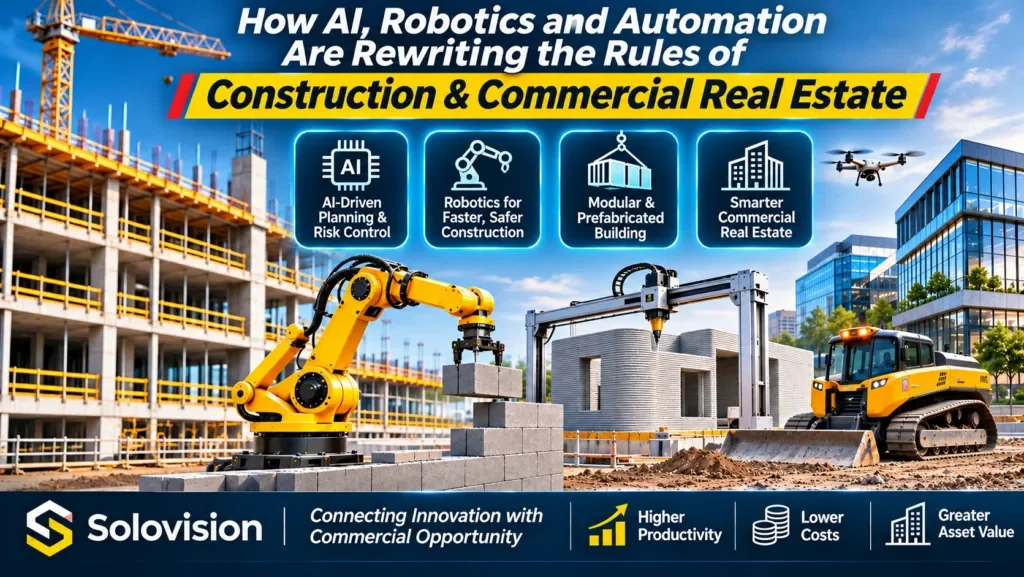
Over the past two decades, the construction industry has managed just a 1% bump in productivity. Meanwhile, manufacturing has been clocking 3.6% growth over the same period. For an industry that underpins the global economy, that gap is a crisis waiting to happen. Throw in skyrocketing material costs and a workforce that is shrinking by the day, and you have the perfect conditions for a technological reckoning. Artificial intelligence, robotics, and automation are no longer just knocking at construction’s door; they are kicking it down.
How AI and Robotics Are Changing Construction Sites
Construction has a long-standing problem with the past. Projects routinely bleed money and miss deadlines, held hostage by outdated workflows and manual processes that have barely changed in generations. Material costs keep climbing, skilled workers are harder to find, and the commercial real estate sector is not faring much better, as bloated operational costs and inefficient property management practices quietly strangle growth and profitability.
The pressure to change has never been this intense. These are industries that have historically treated technology like an unwelcome guest, but that posture is becoming untenable. Artificial intelligence, robotics, and automation now represent something rare in a sector defined by stubbornness: genuine hope. The promise is not abstract; it is measurable, deployable, and increasingly urgent.
Artificial intelligence is leading the charge, and its impact is already tangible. By processing enormous datasets in real time, artificial intelligence systems can flag potential project delays before they spiral, predict when equipment needs maintenance before it breaks down, and sharpen decision-making at every stage of a build. That kind of foresight does not just protect budgets; it saves lives by catching safety risks before they become accidents.
Robotics and automation are doing the heavy lifting, sometimes literally. Bricklaying robots, autonomous excavators, and 3D-printed structures are no longer science fiction. They are active on job sites. These tools eliminate the inconsistency that comes with manual labor, delivering precision at a pace no human crew can match, resulting in faster builds, lower costs, and fewer costly mistakes.
Prefabrication and Modular Methods on the Rise
There is also a broader shift toward modern construction methods, with prefabrication and modular building chief among them. Components built off-site and snapped into place on location mean less waste, less disruption, and dramatically tighter timelines. Projects around the world are already proving what is possible when these methods are executed well, rewriting the old playbook in real time.
Somewhere at the crossroads of technological ambition and commercial pragmatism stands Andrew Taylor. The United Kingdom-based entrepreneur has roots in construction and an increasingly sharp focus on commercial real estate, positioning himself as a compelling voice navigating this transformation. His company, Solovision, exists to close the gap between what technology can do and what the industry is actually doing with it.
The mission is straightforward: connect innovation with commercial opportunity, and help build a more productive, tech-forward built environment. Through industry research, educational media, and deliberate relationship-building, Taylor is working to make those connections real for property owners, investors, and businesses wrestling with everyday operational challenges.
What sets Taylor apart is his refusal to treat technology as an end in itself. For him, it is a means to solve specific, stubborn commercial problems. That grounded, strategic approach is what makes his company worth watching as the industry continues its slow but accelerating pivot toward the future.
For investors and developers paying attention, the technology wave in construction and real estate is not a threat; it is an opening. The ability to spot and evaluate emerging tools early is quickly becoming a competitive differentiator. Better building performance and operational efficiency are the obvious wins, but the deeper prize is long-term asset value, since buildings that run smarter hold their value longer and attract better tenants.
Projects That Already Show the Shift
The proof is already out there. Projects that have leaned into technology, from artificial intelligence-driven energy management to automated construction workflows, are delivering results that prove enhanced efficiency, reduced overhead, and stronger returns are entirely achievable. Strategic partnerships are the accelerant here, as no developer or investor can stay ahead of every technological shift on their own. Collaborating with innovators is how industry leaders will separate themselves from those still waiting to see how things shake out.
The construction and real estate industries have spent decades resisting the kind of disruption that has transformed virtually every other sector of the global economy. That resistance is running out of road. Artificial intelligence, robotics, and automation are proven tools delivering real results on real projects, and the gap between early adopters and everyone else is widening fast.
For industry leaders, the path forward requires courage. Seek out technological solutions actively, build relationships with innovators who understand specific challenges, and utilize platforms that act as bridges to a broader ecosystem of ideas and partnerships. The learning curve is real, but so is the cost of standing still, because the built environment of the coming decade will be shaped by those willing to act now.